
Overview
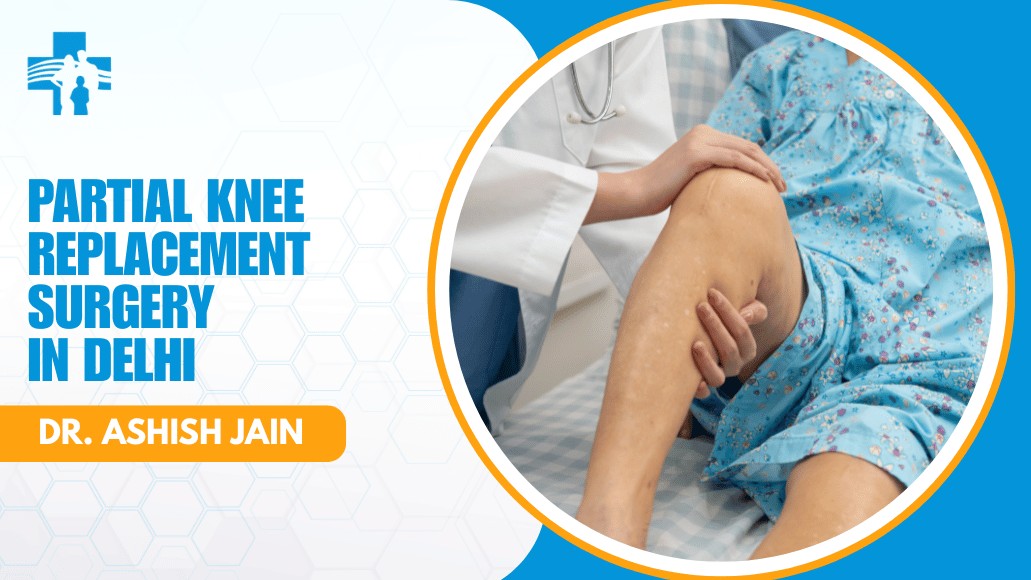
Not every patient with knee arthritis requires a total knee replacement. When damage is confined to a single compartment of the knee, partial knee replacement (also called unicompartmental knee replacement) offers a less invasive, highly effective alternative.
What is Partial Knee Replacement?
Partial knee replacement is a surgical procedure in which only the damaged compartment of the knee joint is replaced, preserving the healthy bone, cartilage, and ligaments.
The knee consists of three compartments:
- Medial (inner)
- Lateral (outer)
- Patellofemoral (front)
If arthritis affects only one compartment, replacing the entire knee may not be necessary. This is where partial knee replacement becomes an ideal option.
Who is an Ideal Candidate for Partial Knee Replacement?
You may be a suitable candidate if:
- Arthritis is limited to one compartment of the knee
- Knee ligaments (especially ACL) are intact
- There is minimal deformity
- Pain is localized rather than widespread
- Non-surgical treatments have failed
A detailed clinical assessment, imaging studies, and functional evaluation at KneeJointReplacement help determine eligibility.
Why Choose Partial Knee Replacement Over Total Knee Replacement?
1. Smaller Surgical Incision
The procedure is less invasive compared to total knee replacement.
2. Faster Recovery
Patients typically experience quicker rehabilitation and shorter hospital stays.
3. Natural Knee Movement
Since healthy ligaments and bone are preserved, movement feels more natural.
4. Less Blood Loss
Reduced surgical trauma results in minimal blood loss.
5. Better Early Mobility
Patients often regain walking ability sooner than with total knee replacement.
Expertise of Dr. Ashish Jain in Partial Knee Replacement
When searching for advanced partial knee replacement in Delhi, surgical precision and patient selection are critical.
Dr. Ashish Jain specializes in:
- Accurate diagnosis of compartment-specific arthritis
- Personalized surgical planning
- Modern implant selection
- Minimally invasive surgical techniques
- Structured rehabilitation guidance
The Surgical Process Explained
Step 1: Preoperative Evaluation
Includes physical examination, X-rays, MRI (if required), and medical fitness assessment.
Step 2: Surgical Procedure
Only the damaged cartilage and bone in the affected compartment are removed and replaced with a precision-fitted implant.
Step 3: Postoperative Recovery
- Early mobilization within 24–48 hours
- Guided physiotherapy
- Gradual strengthening exercises
- Return to routine activities within weeks
Recovery Timeline After Partial Knee Replacement
Although recovery varies by patient, typical progression includes:
- Day 1–2: Assisted walking
- Week 2–3: Reduced pain and improved mobility
- Week 4–6: Resumption of light daily activities
- 3 Months: Significant functional recovery
Because the surgery preserves much of the natural knee structure, recovery is often smoother compared to total knee replacement.
Long-Term Results and Implant Durability
Modern implants used in partial knee replacement are designed for durability and performance. With proper care and activity modification:
- Implants can last 10–15 years or more
- Pain relief is substantial
- Joint function remains stable
Regular follow-ups at KneeJointReplacement ensure long-term joint health.
Why Delhi is a Preferred Destination for Partial Knee Replacement
Delhi has emerged as a center for advanced orthopaedic care due to:
- Experienced joint replacement specialists
- Access to modern surgical technology
- Advanced operation theatres
- Comprehensive rehabilitation programs
When Should You Consult a Specialist?
You should seek expert consultation if:
- Knee pain persists despite medications and physiotherapy
- Pain is localized to one side of the knee
- Walking long distances has become difficult
- Stiffness limits daily activities
Early evaluation helps determine whether partial knee replacement is appropriate before arthritis progresses further.

Conclusion
Partial knee replacement is an advanced, minimally invasive surgical option for patients with localized knee arthritis. By preserving healthy joint structures and replacing only the damaged compartment, it offers faster recovery, natural movement, and long-term pain relief.
FAQs
1. Is partial knee replacement better than total knee replacement?
Ans. It is better for patients whose arthritis is limited to one compartment. Proper patient selection is essential.
2. How long does partial knee replacement surgery take?
Ans. The procedure typically takes 60–90 minutes, depending on complexity.
3. How soon can I walk after partial knee replacement?
Ans. Most patients begin assisted walking within one to two days after surgery.
4. Will I need physiotherapy after surgery?
Ans. Yes, structured physiotherapy is important for strength, flexibility, and optimal recovery.
5. Can partial knee replacement convert to total knee replacement later?
Ans. Yes, if arthritis progresses to other compartments, revision to total knee replacement is possible.