

Your Knee Has Been Trying to Tell You Something
The body stops being subtle at a certain stage in the knee pain journey. The pain that was once occasional becomes constant. Morning stiffness lasts longer. Sitting down feels like relief, but standing back up feels like punishment.
This is not always just ageing. In many patients, it is the knee joint telling them that the damage has gone beyond what medicines, rest, or temporary pain relief can manage.
For patients looking for advanced knee replacement surgery in Delhi, Dr Ashish Jain is one of the most trusted names in the field. With nearly 18 years of focused orthopaedic experience, he helps patients regain mobility, reduce pain, and return to daily life with confidence.
The Problem With Settling for Average Knee Care
Knee replacement surgery is common today, but common does not always mean simple. The outcome depends heavily on correct diagnosis, proper planning, precise implant placement, and structured rehabilitation after surgery.
If an implant is poorly aligned, wrongly sized, or placed without enough surgical precision, patients may continue to experience pain, stiffness, instability, or early implant failure. Many revision surgeries happen because the first surgery did not deliver the expected result.
Advanced knee replacement is not only about replacing a damaged joint. It is about doing it with enough accuracy and care that the new knee works naturally and lasts as long as possible.
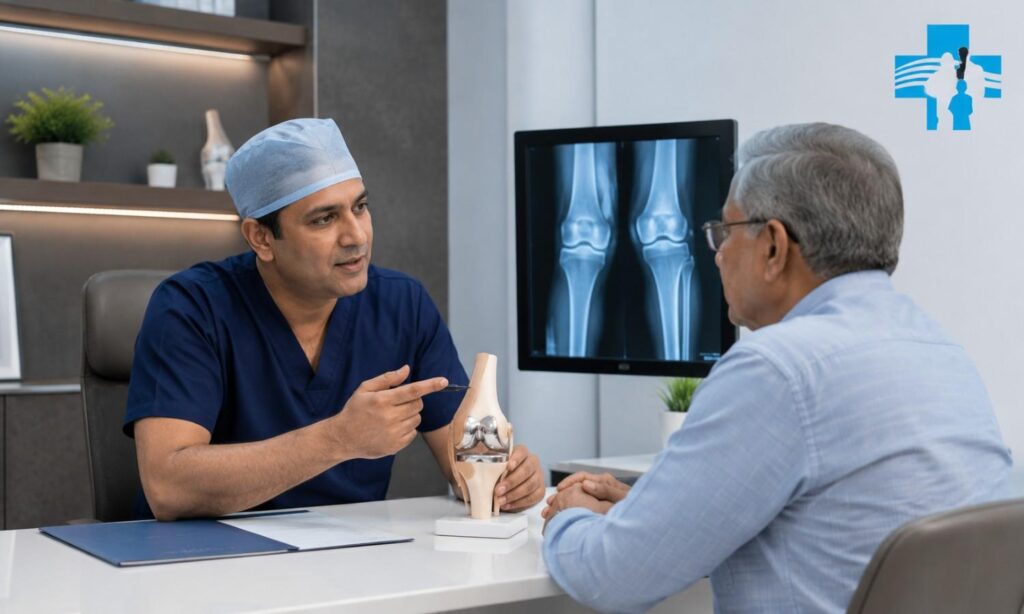
What Proper Advanced Knee Replacement Involves
- Detailed pre-operative planning based on the patient’s knee anatomy and severity of joint damage
- Computer-assisted navigation for accurate implant alignment during surgery
- Implant selection based on age, weight, activity level, and bone quality
- Minimally invasive techniques wherever suitable to reduce tissue trauma
- A structured rehabilitation plan that starts soon after surgery
Each step affects the final result. When any of these steps are rushed or ignored, the patient may feel the difference later during walking, climbing stairs, or daily movement.
Conditions That Bring Patients to Dr Ashish Jain
Some patients visit Dr Ashish Jain early because they want to understand whether surgery is truly needed. Others come after years of managing pain that has become impossible to ignore.
Common conditions treated include:
- Severe osteoarthritis with bone-on-bone contact and major cartilage loss
- Progressive joint damage due to rheumatoid arthritis
- Knee deformity or chronic pain after fractures, ligament injury, or trauma
- Joint degeneration that no longer responds to injections or physiotherapy
- Failed earlier knee replacement requiring revision surgery
The goal is always to evaluate the condition properly before recommending surgery. Conservative options are considered first whenever they can still help.
Types of Knee Replacement Surgery Offered
Total Knee Replacement
In total knee replacement, the damaged joint surfaces are replaced with carefully selected metal and plastic components. This is usually recommended when arthritis or joint damage affects most of the knee.
Dr Ashish Jain uses implant systems with strong long-term records and selects them according to the patient’s joint condition, lifestyle, and expected functional needs.
Partial Knee Replacement
Partial knee replacement may be suitable when only one section of the knee is damaged. It preserves the healthy part of the knee, often allows smoother recovery, and may feel more natural after healing.
This option is recommended only after a proper assessment confirms that the remaining parts of the knee are healthy enough to preserve.

Computer-Assisted Knee Replacement
Computer-assisted knee replacement uses real-time navigation to guide implant placement with a high level of accuracy. This helps improve alignment, reduce long-term wear, and support better functional outcomes.
For many patients, this technology adds an extra layer of precision that can make recovery smoother and implant performance more predictable.
Revision Knee Replacement
Revision knee replacement is performed when a previous knee replacement has failed, become loose, caused persistent pain, or stopped functioning properly. This surgery is more complex than the first replacement and requires careful planning.
Dr Ashish Jain has experience handling complex revision cases, including assessment of old implants, bone quality, soft tissue balance, and reconstruction needs.
About Dr Ashish Jain
Dr Ashish Jain completed his MBBS from Kasturba Medical College, Manipal, and received internationally recognised training in joint replacement surgery. He currently practices at Max Super Speciality Hospital, Shalimar Bagh, and Max PPA Pitampura, New Delhi.
Patients trust him because of his experience, clear communication, and patient-first approach. He takes time to explain the condition, discuss alternatives, and recommend surgery only when it is genuinely needed.
Reasons patients choose him include:
- Nearly 18 years of dedicated experience in knee and joint replacement
- Expertise in minimally invasive and computer-assisted knee replacement techniques
- Experience in complex, bilateral, and revision knee replacement cases
- Detailed consultation before any surgical recommendation
- Transparent guidance focused on long-term patient recovery
A Note on Recovery After Knee Replacement
Recovery is not an afterthought. It is a major part of successful knee replacement treatment.
With guided physiotherapy after knee replacement, patients gradually rebuild strength, balance, and walking confidence. Most patients begin assisted walking within 24 hours, depending on their health and surgical plan.
A personalised rehabilitation programme helps patients return to daily activities safely. Many patients resume routine movement within 6 to 12 weeks, although recovery timelines vary from person to person.
Is It Time to Have the Conversation?
If knee pain is affecting your sleep, walking, stairs, or independence, it may be time to speak to a specialist. A consultation does not mean immediate surgery. It means getting a clear assessment of where your knee stands and what options are still available.
To understand whether knee replacement surgery in Delhi is right for you, schedule a consultation with Dr Ashish Jain at Max Super Speciality Hospital, Shalimar Bagh.
Book your consultation: Contact Dr Ashish Jain | Call: +91-97170 35556
Frequently Asked Questions
Q. How do I know if I actually need knee replacement surgery?
If you have severe, persistent knee pain that does not improve with physiotherapy, medicines, or injections, and your daily life is significantly affected, you should get a specialist assessment.
Q. What happens if a knee replacement is not done precisely?
Poor implant alignment can lead to ongoing pain, stiffness, instability, and early implant failure. This is why surgical planning and precision are as important as the implant itself.
Q. Can Dr Ashish Jain fix a previously failed knee replacement?
Yes. Revision knee replacement is one of his areas of expertise. Each case is assessed individually to decide the safest and most effective approach.
Q. Where does Dr Ashish Jain practice in Delhi?
Dr Ashish Jain practices at Max Super Speciality Hospital, Shalimar Bagh, and Max PPA Pitampura, New Delhi.