
A top knee pain specialist doctor will begin with a detailed history and a physical examination of your knee, followed by an X-ray and, if needed, an MRI. They will then explain the cause of your pain and offer non-surgical options first, such as exercises, medicines, injections and weight management. Surgery is discussed only when other treatment has not worked or the joint damage is advanced.
Overview
Plenty of people put off seeing a knee specialist because they are not sure what will happen. Will they be told they need surgery on day one? Will there be a long list of expensive scans? The honest answer is that a good specialist does the opposite: listens first, examines carefully, orders only the tests that matter and starts with the simplest treatment that can work. If your knee has been troubling you, you can book a knee pain consultation with Dr. Ashish Jain and see for yourself.
Dr. Ashish Jain is a joint replacement surgeon at Max Super Speciality Hospital in Shalimar Bagh, and his patients come from across North Delhi. You can read more about our top knee pain specialist doctor in North Delhi page, or our earlier guide on which doctor treats knee pain best in North Delhi. This post is about the visit itself.
What Happens at Your First Visit to a Knee Specialist?
In order
● You describe your pain, when it started and what makes it better or worse
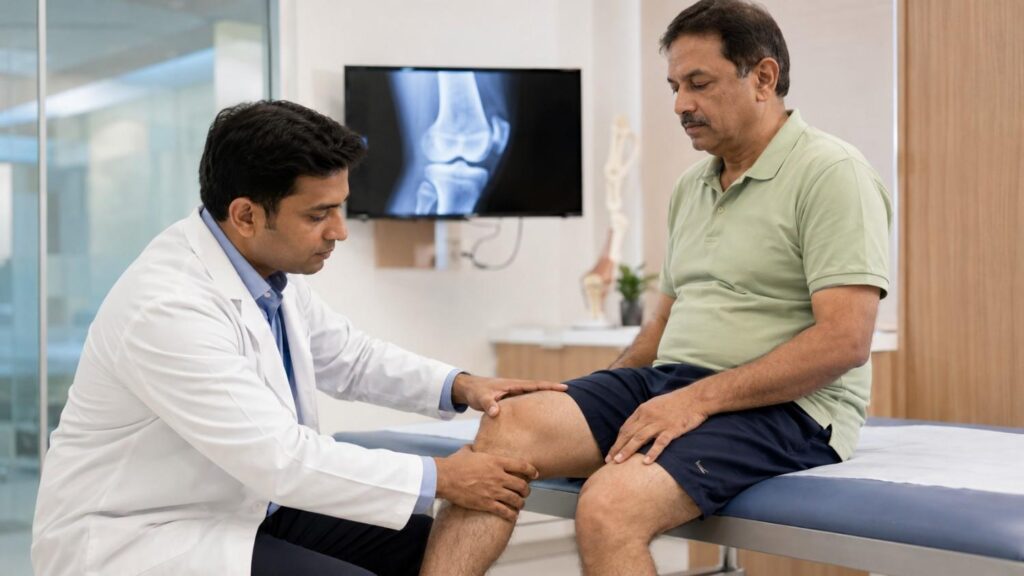
● The doctor examines the knee, checks movement, swelling and alignment, and watches you walk
● An X-ray is taken if you do not have a recent one
● An MRI or other tests are advised only if they will change the plan
● You leave with a clear explanation and a plan
A good first visit leaves you understanding your knee, not just holding a prescription.
Meet Dr. Ashish Jain, Knee Specialist at Max Super Speciality Hospital
Dr. Ashish Jain is an internationally trained joint replacement surgeon with 18 years of experience in knee replacement. He completed his MBBS at Kasturba Medical College, Manipal. His practice includes treatment for arthritis, joint replacement and fracture fixation, and he is known for suggesting non-surgical options before surgery when they are appropriate.
Professional Highlights
● MBBS, Kasturba Medical College, Manipal
● Internationally trained in joint replacement
● 18 years of experience in knee replacement surgery
● Treatment for arthritis, joint replacement and fractures
Call +91-97170 35556, email DrAshishJRobotics@gmail.com or WhatsApp the clinic.
What Questions Will the Doctor Ask You?
Be ready to answer
● Where exactly does it hurt: front, inside, outside or behind the knee?
● Is the pain worse on stairs, at night or after sitting?
● Is there swelling, locking, clicking or a feeling of giving way?
● Have you had a past injury or surgery on the knee?
● What medicines, injections or exercises have you already tried?
● How is the pain affecting your daily life?
Your answers help the doctor separate arthritis from a ligament, meniscus or other problem. If you want a quick self-check before you come in, read our guide on when knee pain crosses the line from manageable to medical and five signs you need a knee pain specialist.
What Tests Might You Need?
1. X-ray
An X-ray shows the joint space, bone changes and alignment. It is usually the first test.
2. MRI
An MRI is useful for ligament, meniscus or cartilage problems. It is not needed for every knee.
3. Blood Tests
Sometimes advised if inflammatory arthritis or infection is suspected.
Ask why each test is needed. If it will not change the treatment, it may not be needed.
What Treatment Options Will You Be Offered?
1. Exercises and Physiotherapy
Strengthening the muscles around the knee takes load off the joint. Our physiotherapy service and our guide to hydrotherapy for joint pain relief explain how this helps.
2. Medicines and Weight Management
Anti-inflammatory medicines, supplements the doctor advises, and weight loss, if needed, can reduce symptoms noticeably.
3. Injections
Some patients get relief from injections, though not all. Read whether knee injections can delay surgery to understand what to expect.
4. Arthritis Care and Other Treatments
For long-term joint pain, see our treatment for arthritis page and our blog on alternatives to knee joint replacement surgery.
5. Surgery
When pain is severe and other treatments have not helped, surgery may be discussed. That could be partial or total knee replacement. See when knee replacement is actually necessary for how this decision is made.
Why Choose Dr. Ashish Jain as Your Knee Pain Specialist?
Key advantages
● A surgeon with 18 years of knee replacement experience
● International training in joint replacement
● A non-surgical-first approach where it makes sense
● Practising at Max Super Speciality Hospital, Shalimar Bagh
● Plain-language explanations, with updates on Instagram
For general prevention tips, see our guide to five effective tips for preventing knee pain.
Signs You Should See a Knee Specialist Soon
● Pain lasting more than a few weeks
● Swelling, warmth or redness around the knee
● A knee that locks or gives way
● Difficulty with stairs or getting up from a chair
● Pain that wakes you at night
What Is the Knee Pain Journey With Dr. Ashish Jain?
- Consultation: History and a careful examination of the knee.
- Tests: X-ray, and an MRI only if needed.
- Diagnosis: A clear explanation of the cause.
- Treatment plan: Non-surgical options first where suitable.
- Follow-up: Review to check your progress.
What Are the Benefits of Seeing a Specialist Early?
✔ An accurate diagnosis instead of guesswork
✔ Simple treatments started before damage advances
✔ Fewer unnecessary tests and medicines
✔ A clear idea of whether surgery will ever be needed
✔ Faster return to everyday activity
How Do You Care for Your Knee Between Visits?
Your daily habits matter as much as any injection or tablet. Keep moving gently, strengthen the thigh muscles and avoid long periods of sitting with the knee bent.
Everyday habits
● Do the exercises you were shown, regularly
● Maintain a healthy weight
● Avoid squatting and sitting cross-legged if it hurts
● Use stairs with a handrail
● Report any new swelling or sudden pain
Small daily habits often decide how long a knee lasts without surgery.
Why Do North Delhi Patients Trust Dr. Ashish Jain?
● Honest advice, including when surgery is not needed
● A calm, clear explanation of every option
● Convenient access in Shalimar Bagh
● Patient education videos on YouTube
● Joint replacement expertise if you ever need it
Conclusion
A good knee pain specialist does not rush you into surgery or into scans. They listen, examine, test only what is needed and start with the simplest treatment that works. If your knee has been bothering you for weeks, a single consultation can tell you what is wrong and what to do about it. Dr. Ashish Jain and his team are ready to see you.
Contact Dr. Ashish Jain
Email: DrAshishJRobotics@gmail.com
Phone: +91-97170 35556
Book your knee pain consultation with Dr. Ashish Jain here
FAQs
What happens at a first visit to a knee pain specialist?
The doctor takes your history, examines the knee and orders an X-ray, and an MRI only if needed. You then get a clear diagnosis and treatment plan.
Will the doctor tell me I need surgery straight away?
Not usually. Non-surgical options such as exercises, medicines and injections are tried first unless the damage is advanced.
Do I need an MRI for knee pain?
Not always. An X-ray is often enough. An MRI is advised when a ligament, meniscus or cartilage problem is suspected.
Which knee pain specialist doctor should I see in North Delhi?
Choose a doctor who examines you carefully, explains the options and does not push surgery. You can WhatsApp us to book a visit with Dr. Ashish Jain.
How can I prepare for my first visit?
Bring your old X-rays and reports, a list of medicines and a note of when the pain started and what makes it worse.