
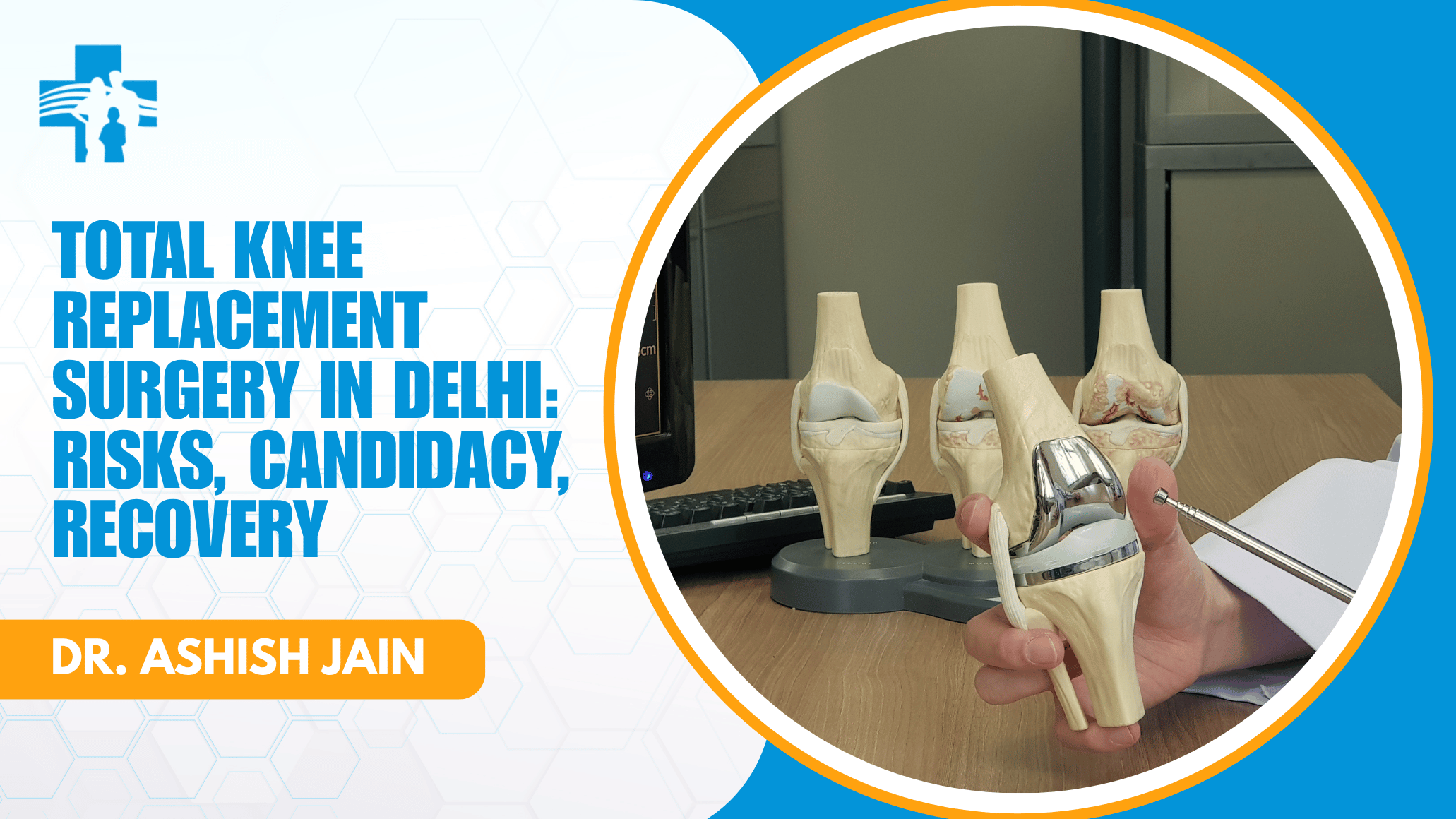
Total knee replacement is a surgery in which the damaged surfaces of the knee joint are replaced with a metal and medical-grade plastic implant to relieve pain and restore movement. It is usually considered when severe arthritis or joint damage limits daily life and simpler treatments have stopped working. Most people begin walking with support within a day or two and recover over several weeks to months. A surgeon should assess your knee, your overall health and your risks before any decision. You can book a consultation here.
Overview
Most people do not wake up one day and decide they need a knee replacement. It builds slowly. First you avoid the stairs, then you stop going for evening walks, then even getting out of a chair feels like a negotiation. By the time someone searches for total knee replacement surgery in Delhi, they have usually tried tablets, creams, physiotherapy and sometimes injections, and they want a straight answer: is surgery really needed, how risky is it, and what will the recovery look like?
Dr. Ashish Jain is a joint replacement and reconstruction specialist who operates at Max Super Speciality Hospital, Shalimar Bagh and Max PPA Pitampura. This guide is written to answer the questions patients usually ask in the consultation room. It covers who is a good candidate, who should wait, what the real risks are, how surgery is done and what recovery looks like, week by week. You can also read about the procedure on our total knee replacement page.
What Is Total Knee Replacement?
In simple words
● A surgery that replaces the worn surfaces of the knee joint with artificial parts
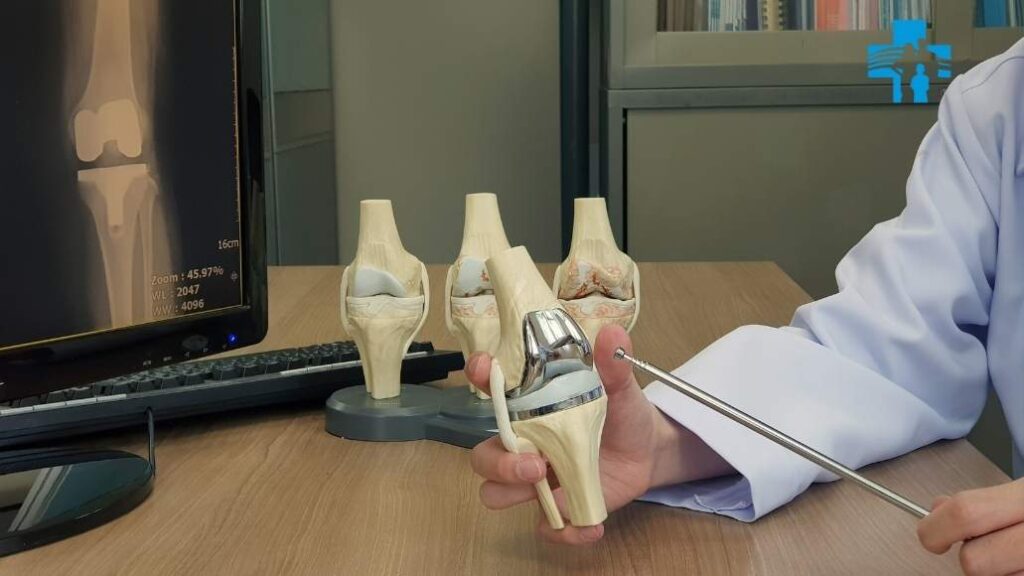
● The implant usually includes a metal part on the thigh bone, a metal part on the shin bone and a plastic spacer between them
● It removes the rough, damaged surfaces that cause bone-on-bone pain
● It is different from partial replacement, which treats only one section of the knee
● The goal is less pain and better movement, not a “new young knee”
Knee replacement is a pain-relief and function-restoring surgery. It is not a cosmetic or a first-line treatment.
Meet Dr. Ashish Jain
Dr. Ashish Jain holds an MBBS from Kasturba Medical College, Manipal, and is described on the clinic website as a joint replacement and reconstruction specialist. The site states that he is internationally trained and focuses on minimally invasive joint replacement techniques. He consults and operates at Max Super Speciality Hospital, Shalimar Bagh and Max PPA Pitampura.
Professional Highlights
● MBBS, Kasturba Medical College, Manipal
● Joint Replacement and Reconstruction Specialist
● Works with knee, hip and shoulder joint replacement
● Consults and operates at Max Shalimar Bagh and Max PPA Pitampura
See patient education videos on the clinic’s YouTube channel, or call +91 97170 35556 to ask about a consultation.
Who Is a Good Candidate for Total Knee Replacement?
Candidacy is not decided by age alone. Doctors look at how much the knee affects your life, what the X-rays show and whether other treatments have helped.
Signs that surgery may be worth discussing
● Constant knee pain that limits walking, stairs or sleep
● Pain that continues even at rest or at night
● Stiffness or swelling that does not settle with treatment
● A knee that is visibly bent inward or outward
● X-rays showing advanced joint damage
● Little or no lasting relief from physiotherapy, medicines or injections
If your pain is mainly on one side of the knee, a partial option may be worth discussing. Our post on unicompartmental knee arthroplasty explains when that applies. For a decision-focused read, see when knee replacement surgery is actually necessary.
Who Should Wait or Be Assessed Carefully First?
Surgery is not always the right answer right now. A good surgeon will tell you honestly when to wait.
Situations that need extra attention
● An active infection anywhere in the body, including the skin around the knee, the teeth or the urinary tract
● Poorly controlled diabetes or blood pressure
● Heart, lung or kidney conditions that need optimisation first
● Very high body weight, which can raise risks and may need a plan
● Poor skin condition or open wounds near the knee
● Mild arthritis that may still respond to non-surgical care
● Unrealistic expectations, such as expecting to return to heavy impact sport
Many of these are not permanent “nos”. They are “not yet, let us fix this first”.
What Are the Risks of Knee Replacement?
Every surgery carries risk, and a trustworthy consultation talks about it openly. The numbers vary by patient health and hospital, so ask your surgeon how they apply to you.
1. Infection
Infection in the wound or around the implant is uncommon but serious. Hospitals use sterile technique and antibiotics to reduce it. You can read the warning signs in our post on knee replacement infection.
2. Blood Clots
Clots can form in the leg veins after surgery. Early walking, ankle movements and, where advised, blood-thinning medicines help prevent them.
3. Stiffness
Some knees become stiff if movement is not regained in the early weeks. This is one reason physiotherapy matters.
4. Implant Wear or Loosening
Implants do not last forever. Over many years they can wear or loosen. See how long knee replacements actually last.
5. Other Risks
These include persistent pain in a small number of people, injury to nearby nerves or blood vessels, swelling and anaesthesia-related effects. Ask the team how your health conditions change these risks.
How Is the Surgery Done?
The surgeon removes the damaged surface of the thigh bone and shin bone, shapes the bone to fit the implant and fixes the components in place. The knee is then tested for movement and stability before the wound is closed. Some hospitals also use computer-assisted or robotic tools to plan bone cuts. The clinic’s page on computer assistance surgery describes this in more detail.
Surgery usually takes around one to two hours, though this depends on the case. A hospital stay of a few days is common, but your own plan may differ.
Why Choose Dr. Ashish Jain for Knee Replacement?
Key advantages
● A surgeon whose practice is focused on joint replacement and reconstruction
● Consultation and surgery at Max Shalimar Bagh and Max PPA Pitampura
● Minimally invasive approaches discussed where suitable
● Honest guidance on when surgery is and is not needed
● Physiotherapy support through the clinic’s physiotherapy services
Ask questions on WhatsApp at wa.me/9599949945, or book your consultation here.
What Is the Treatment Journey?
- Consultation and examination: The surgeon examines your knee, checks movement and alignment and reviews your history.
- Tests and imaging: X-rays and, if needed, blood tests, ECG and other checks assess the joint and your fitness for surgery.
- Pre-surgery preparation: Medicines are reviewed, health conditions are optimised and you learn what to expect. See our guide to preparing for knee replacement.
- Surgery and hospital stay: The knee is replaced, pain is managed and you are helped to stand and walk early.
- Rehabilitation and follow-up: Physiotherapy and review visits guide your recovery over the following weeks and months.
What Are the Benefits of Total Knee Replacement?
✔ Significant reduction in arthritis pain for most patients
✔ Better ability to walk, climb stairs and get up from a chair
✔ Straighter alignment when the knee was bent by arthritis
✔ Better sleep when night pain settles
✔ A return to many everyday activities and low-impact exercise
What Does Recovery Look Like Week by Week?
Everyone heals at their own pace, and your surgeon and physiotherapist will set your own plan. This is a general picture.
A typical outline
● Day 1 to 3: Standing and first steps with a walker or support, ankle pumps and early knee bending
● Week 1 to 2: Wound care, swelling control, regular exercises and short walks at home
● Week 2 to 6: Walking improves, stairs become easier and many people shift from a walker to a stick
● Week 6 to 12: Strength and balance improve, and most daily activities become comfortable
● Month 3 to 6: Swelling settles gradually and the knee feels more natural
For more detail, read our recovery timeline from day 1 to week 6 and when you can drive again.
The first six weeks decide a lot. Show up for your physiotherapy, even on the days it feels hard.
Why Do Delhi Patients Trust Dr. Ashish Jain?
● Clear explanations of risks as well as benefits
● Surgery at well-known hospitals in North and North-West Delhi
● A focus on early movement and structured rehabilitation
● Patient information shared on Instagram
● Easy contact by phone, email and WhatsApp
Conclusion
Total knee replacement can be life-changing when arthritis or joint damage has taken away your ability to walk, climb stairs or sleep comfortably. It is not for every knee and every patient, and it carries real risks that should be discussed openly. Good candidacy, good preparation and consistent rehabilitation make the biggest difference to results. If you are in Delhi and want a clear opinion on whether you need surgery or can wait, Dr. Ashish Jain’s team can examine your knee and explain your options honestly.
Contact Dr. Ashish Jain
Email: DrAshishJRobotics@gmail.com
Phone: +91 97170 35556
Book your knee consultation here
FAQs
Who needs a total knee replacement?
People with severe knee arthritis or joint damage that causes constant pain, stiffness or deformity and has not improved with non-surgical treatment are usually considered.
What are the main risks of total knee replacement?
Risks include infection, blood clots, stiffness, implant wear or loosening over time and anaesthesia-related effects. Your surgeon can explain how they apply to your health.
How long does recovery take after total knee replacement?
Many people walk with support within a day or two and manage most daily activities within a few weeks, but full recovery often takes several months.
Who should avoid or delay knee replacement?
Anyone with an active infection, poorly controlled diabetes or blood pressure, or untreated heart, lung or kidney problems may need to wait until these are optimised.
Where can I get total knee replacement surgery in Delhi?
You can consult Dr. Ashish Jain at Max Super Speciality Hospital, Shalimar Bagh or Max PPA Pitampura, call +91 97170 35556 or write to DrAshishJRobotics@gmail.com.