
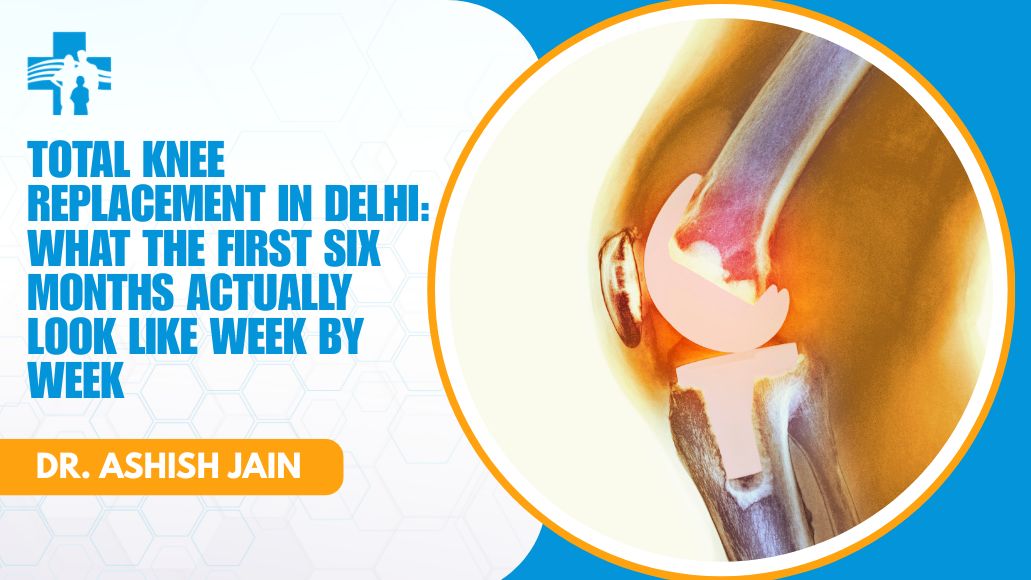
Overview
Most people research total knee replacement surgery thoroughly before deciding to proceed. They understand the procedure well enough. What they are less prepared for is what happens after the surgery, specifically what the recovery actually looks like on a week-by-week basis and what to expect at each stage.
The recovery from total knee replacement is not passive. It is an active process that requires consistent effort, patience, and a clear understanding of what is normal at each stage versus what needs attention. Patients who go in with this understanding do better than those who are surprised by the process.
Dr Ashish Jain performs total knee replacement at Max Super Speciality Hospital, Shalimar Bagh, using minimally invasive techniques that reduce tissue disruption and support faster recovery. This is an honest account of what the first six months actually look like.
Before Surgery: What Preparation Actually Matters
The recovery starts before the surgery. Stronger patients going in come out faster. Pre-operative physiotherapy to strengthen the quadriceps, hamstrings, and hip muscles gives the knee better support from the moment the new joint begins bearing load.
Blood tests, cardiac evaluation, and assessment of any other health conditions are completed before the surgical date. Medications that affect bleeding are paused in the days before surgery. Arrangements for home support for the first two to four weeks after discharge are made in advance because mobility will be limited enough that having help matters.
Week One: The Hardest Week
The surgery itself takes between 1.5 and 2.5 hours. Most patients spend 3 to 5 days in the hospital before discharge.
Physiotherapy begins within 24 hours of surgery. This sounds aggressive to most patients, but early movement is one of the most important factors in preventing complications and maintaining joint mobility during healing. The first exercises are gentle, focused on activating the muscles and getting the joint moving within a safe range.
Pain during this week is managed with medication. It is present but controlled. The knee will be swollen, bruised, and warm. All of this is normal. Walking with a frame starts within 24 to 48 hours of surgery. The distance is short, but starting is the point.
Weeks Two to Four: Leaving Hospital Behind
By week two, most patients are home. Mobility improves noticeably, but the knee is still significantly swollen, and the range of motion is limited. A walker or crutches are still needed for most movement.
Physiotherapy exercises at home are essential during this period. The exercises provided by Dr Ashish Jain’s team need to be done consistently rather than occasionally. The muscles around the new joint are relearning their function, and the exercises are what drive that process.
The swelling starts reducing gradually but remains significant for several weeks. Elevating the leg when resting and applying ice for pain and swelling management are part of the daily routine.
By week four, most patients are transitioning from a walker to a single crutch or walking stick. Short walks outside become possible. Stairs are manageable with support but still take effort.
Weeks Four to Eight: Building Function
Structured physiotherapy through this stage is what determines how much range of motion and strength a patient regains long-term.
This is where progress starts to feel more real. The walker is typically no longer needed by week six for most patients. Walking distances increase. The knee starts feeling more like part of the body rather than a foreign object.
Driving is not yet safe in most cases. The reaction time and leg strength needed for safe driving are not reliably restored until around six to eight weeks, and longer for left knee replacement in manual vehicles. Dr Ashish Jain’s team advises specifically on when driving can resume based on individual progress.
Range of motion exercises become more intensive during this period. Achieving 90 degrees of knee flexion is the typical goal at the six-week mark. Regular physiotherapy assessments track progress and adjust the exercise programme accordingly.
Physiotherapy at Dr Ashish Jain’s practice is a structured component of care throughout recovery rather than a suggestion patients can opt in or out of.
Months Two to Four: Returning to Normal
Most patients return to light daily activities between six and ten weeks. The knee is still working hard in the background. Fatigue at the end of the day is normal and reflects the ongoing healing process rather than a problem.
Range of motion continues improving. By three months, most patients have significantly more comfortable movement than before surgery, often more than they had expected given how the first weeks felt.
The swelling reduces substantially, though some mild puffiness around the knee persists for up to a year in many patients. This is normal and does not indicate a problem.
Months Four to Six: Full Recovery Builds
Full recovery, meaning maximum strength, complete range of motion, and total confidence in the joint, builds over three to six months. The implant is doing what it is supposed to do. The muscles have largely regained their strength. Most patients at this stage have returned to most activities they enjoyed before the knee problem became severe.
The computer-assisted surgery that Dr Ashish Jain uses for precision implant placement means the joint functions as naturally as possible, which supports the quality of this longer-term recovery significantly.
Conclusion
Total knee replacement recovery is a six-month process that requires active participation at every stage. The patients who do best are those who understand what to expect, commit to the physiotherapy programme, and communicate with Dr Ashish Jain’s team when anything feels outside the expected range. The result at the end of that process is a functional, pain-free joint that most patients say they wish they had not delayed having done.
Frequently Asked Questions
Q. How long after a total knee replacement can I walk normally in Delhi?
Most patients walk without any aid for six to eight weeks. A fully natural, confident gait develops over three to six months as strength and range of motion improve.
Q. Is the recovery from minimally invasive knee replacement faster?
Yes. Less tissue disruption during surgery means less post-operative pain, reduced swelling, and earlier mobilisation compared to the conventional open technique. Dr Ashish Jain is a pioneer in minimally invasive joint replacement techniques.
Q. Can both knees be replaced at the same time?
Bilateral simultaneous replacement is possible in selected cases. Most surgeons prefer staging the procedures with a gap between them to allow adequate recovery from each. Dr Ashish Jain discusses the most appropriate approach based on each patient’s health and clinical situation.
Q. What are the signs that something is wrong during recovery?
Increasing rather than decreasing pain after the first week, significant new swelling, redness spreading from the incision, fever, or calf pain or swelling should all be reported to Dr Ashish Jain’s team promptly.
CTA