
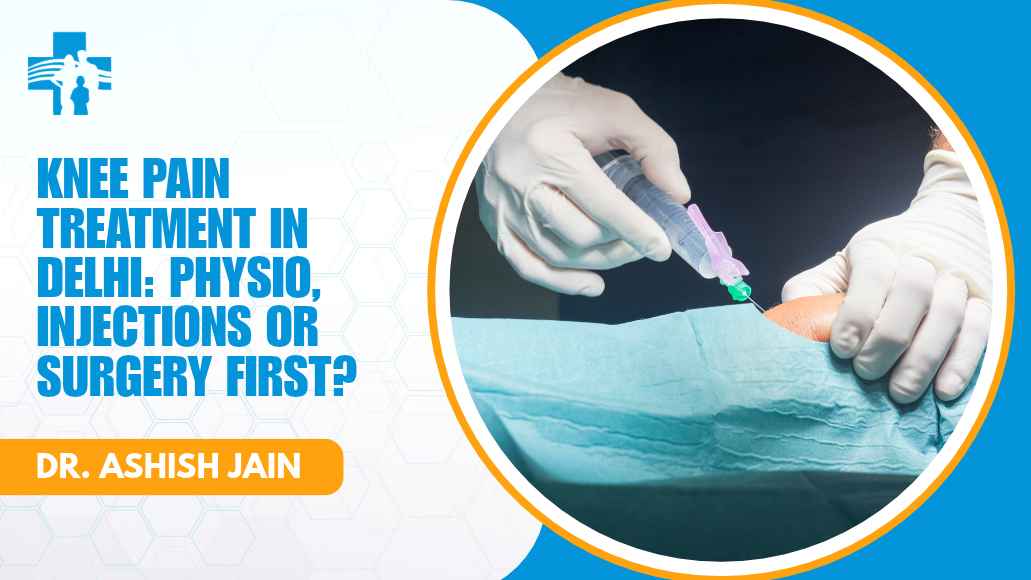
Knee pain treatment usually follows a step-by-step path: lifestyle changes and weight management, physiotherapy and strengthening, pain medicines, injections in selected cases and, only when other options stop helping, surgery. Physiotherapy and injections can reduce symptoms but do not rebuild worn cartilage, so the right choice depends on the cause, the stage of arthritis and how much the knee limits your life. An orthopaedic assessment comes first. You can book a consultation here.
Overview
If you have knee pain, you have probably already been given three different pieces of advice. One person says “do physiotherapy”. Another says “take an injection, it works”. A third says “you need replacement, do not delay”. All three can be right for different people, and all three can be wrong for you.
The problem is that most advice skips the middle question: what stage is your knee at? Early arthritis, a meniscus tear, a ligament injury and severe bone-on-bone damage need very different answers. Dr. Ashish Jain, a joint replacement and reconstruction specialist who consults at Max Super Speciality Hospital, Shalimar Bagh and Max PPA Pitampura, usually starts with the least invasive option that can work and moves up only when it is needed. This guide explains what each option does, where it falls short and how to know when it is time to move to the next step. You can also read our overview of non-surgical and surgical knee pain treatment.
What Is the Treatment Ladder for Knee Pain?
In simple words
● A sequence of treatments, from the gentlest to the most invasive
● Early steps work best when the joint is still relatively healthy
● Later steps are for severe damage or when nothing else helps
● You can combine steps, for example physiotherapy with weight loss
● You may move up and down the ladder as your symptoms change
The right treatment is the least invasive one that actually works for your knee.
Meet Dr. Ashish Jain
Dr. Ashish Jain holds an MBBS from Kasturba Medical College, Manipal, and is described on the clinic website as a joint replacement and reconstruction specialist. The site states that he is internationally trained and focuses on minimally invasive joint replacement techniques. He consults and operates at Max Super Speciality Hospital, Shalimar Bagh and Max PPA Pitampura.
Professional Highlights
● MBBS, Kasturba Medical College, Manipal
● Joint Replacement and Reconstruction Specialist
● Works with knee, hip and shoulder joint replacement
● Consults and operates at Max Shalimar Bagh and Max PPA Pitampura
See exercise and knee care videos on the clinic’s YouTube channel, or call +91 97170 35556 to ask about a consultation.
Step 1: Lifestyle Changes and Weight Management
Every extra kilo adds load to the knee with each step, so even modest weight loss can reduce pain over time. Choosing low-impact activity such as walking on flat ground, cycling or swimming, and avoiding repeated deep squatting and heavy stair climbing, can also help.
Simple changes that matter
● Reduce body weight if you are overweight
● Walk on flat surfaces and avoid prolonged sitting cross-legged or squatting
● Use a support or cane if it takes load off the painful knee
● Wear comfortable, cushioned footwear
● Stay moving, because complete rest weakens the muscles that protect the knee
You can also see our post on five effective tips for preventing knee pain.
Step 2: Physiotherapy and Strengthening
Physiotherapy strengthens the muscles around the knee, improves flexibility and balance and teaches you how to move without overloading the joint. For many people with early to moderate arthritis, it is the single most useful treatment.
What physiotherapy can do
● Reduce pain and stiffness by strengthening the thigh and hip muscles
● Improve walking, balance and confidence on stairs
● Prepare the knee and body for surgery if it becomes necessary
● Speed up recovery after surgery
What it cannot do
● Regrow worn cartilage
● Straighten a knee that is badly bent by arthritis
● Replace the need for surgery when the joint is badly damaged
The clinic offers physiotherapy services, and our post on exercises before and after knee surgery gives examples.
Step 3: Medicines and Supports
Doctors may suggest pain relievers or anti-inflammatory medicines for flare-ups, and sometimes a knee brace or insoles. These reduce symptoms but do not change the condition of the joint. Long-term use of some medicines can affect the stomach, kidneys or blood pressure, so take them only as advised.
Step 4: Injections
Injections are often misunderstood. They can help in selected patients, but they are not a cure.
What they may offer
● Corticosteroid injections: Often used for short-term relief during a painful flare-up
● Hyaluronic acid and similar injections: Used by some doctors to improve lubrication, though research findings on their benefit are mixed
● PRP and other biological injections: Used by some clinics, but evidence is still developing and results vary
Things to remember
● Injections do not rebuild lost cartilage
● Relief may last weeks or months, but it varies
● Repeated injections are not always advisable
● Their usefulness depends on the stage of arthritis
For more detail, read can knee injections actually delay surgery.
Step 5: Surgery
When pain is constant, the knee is badly damaged and other treatments have stopped working, surgery may be the right step. Options depend on what is wrong.
● Partial knee replacement: When damage is limited to one section of the knee. See what unicondylar replacement involves.
● Meniscal procedures: In selected cases of cartilage damage, as described in our post on meniscal replacement.
● Total knee replacement: When the whole joint is badly worn. See our total knee replacement page.
Surgery is a bigger decision, but it is not a failure. When the joint is badly damaged, it can be the treatment that finally gives you your life back.
Why Choose Dr. Ashish Jain for Knee Pain?
Key advantages
● A surgeon who starts with the least invasive option that can work
● Non-surgical, physiotherapy and surgical options discussed in one place
● Consultation and surgery at Max Shalimar Bagh and Max PPA Pitampura
● Minimally invasive approaches discussed where suitable
● Honest advice about when surgery is not yet needed
Ask questions on WhatsApp at wa.me/9599949945, or book your consultation here.
Signs It May Be Time to Move Up a Step
● Pain that has not improved despite weeks of physiotherapy
● Relief from injections that is getting shorter each time
● Pain at rest or at night that disturbs your sleep
● Difficulty walking short distances or climbing a few stairs
● A knee that is visibly bent, swollen or unstable
● Dependence on painkillers to get through the day
● Giving up activities you enjoy because of the knee
What Is the Treatment Journey?
- Consultation and examination: The surgeon examines the knee, checks movement and alignment and listens to your history.
- Imaging: X-rays, and sometimes MRI, show the stage of arthritis or the type of injury.
- Treatment plan: You discuss lifestyle changes, physiotherapy, medicines or injections where suitable.
- Review: Your progress is checked after a few weeks, and the plan is adjusted.
- Surgical planning if needed: If non-surgical care is not enough, the options and timing of surgery are explained in detail.
What Are the Benefits of the Stepwise Approach?
✔ Avoids unnecessary surgery when simpler treatment is enough
✔ Builds muscle strength that helps in every stage of treatment
✔ Reduces reliance on painkillers
✔ Prepares you better if surgery eventually becomes necessary
✔ Lets you decide with clear information, without pressure
What Should Self-Care Look Like?
Good self-care supports every step of treatment. Your doctor will tell you what suits your knee.
Simple guidelines
● Do your physiotherapy exercises regularly, not only when the knee hurts
● Apply ice or heat as advised to manage swelling and stiffness
● Maintain a healthy weight
● Avoid activities that clearly aggravate the pain
● Take medicines only as prescribed
● Report sudden swelling, redness, fever or a locked knee early
● Keep follow-up appointments
Consistency matters more than intensity. A little exercise every day beats a lot once a week.
Why Do Delhi Patients Trust Dr. Ashish Jain?
● A clear explanation of why a treatment is or is not needed
● Convenient hospital locations in Shalimar Bagh and Pitampura
● Patient education on Instagram
● Physiotherapy and surgical expertise under one practice
● Easy contact by phone, email and WhatsApp
Conclusion
Knee pain treatment is not a choice between “physio” and “surgery”. It is a ladder, and the goal is to climb only as far as your knee needs. Lifestyle changes and physiotherapy help many people, injections can offer temporary relief in selected cases and surgery is the answer when the joint is badly damaged. If you are in Delhi and unsure which step you are on, Dr. Ashish Jain’s team can examine your knee, review your scans and recommend the least invasive treatment that is likely to work.
Contact Dr. Ashish Jain
Email: DrAshishJRobotics@gmail.com
Phone: +91 97170 35556
Book your knee consultation here
FAQs
Should I try physiotherapy before knee replacement?
In most cases, yes. Physiotherapy often helps early to moderate arthritis and also prepares you for surgery if it becomes necessary.
Can knee injections cure arthritis?
No. Injections may reduce pain for a period, but they do not rebuild worn cartilage, and results vary from person to person.
When is knee surgery the better option?
When pain is constant, the joint is badly damaged and physiotherapy, medicines and injections have stopped helping.
Can exercises make knee pain worse?
The wrong exercises can. A physiotherapist can choose and adjust exercises to suit your knee.
Where can I get knee pain treatment in Delhi?
You can consult Dr. Ashish Jain at Max Super Speciality Hospital, Shalimar Bagh or Max PPA Pitampura, call +91 97170 35556 or write to DrAshishJRobotics@gmail.com.