
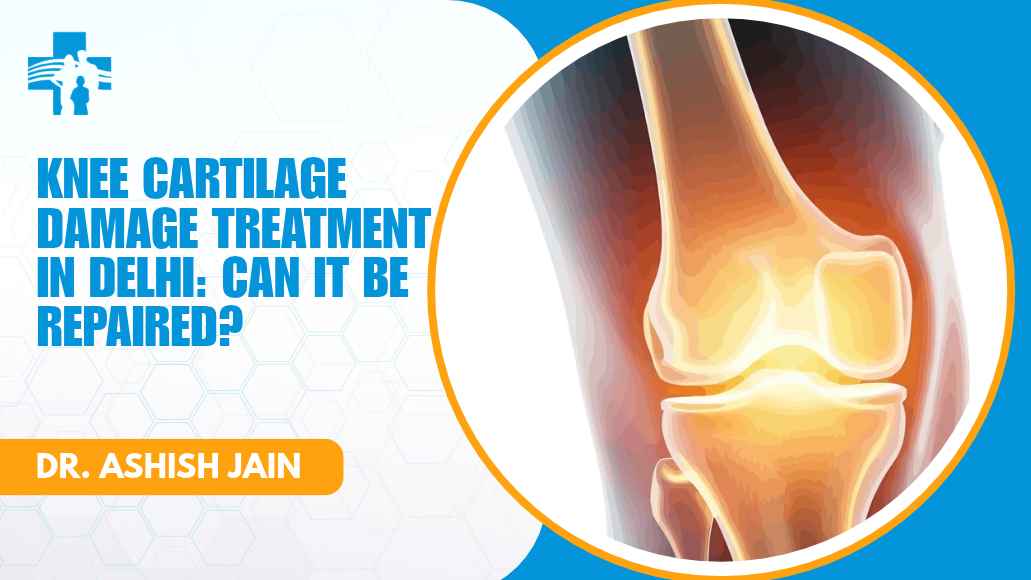
Knee cartilage damage treatment depends on the size and location of the damage, your age, your activity level and whether arthritis is already present. Small, early problems are often managed with activity changes, physiotherapy and weight control. Larger or painful defects may be considered for surgery, such as microfracture or cartilage repair procedures. Cartilage has a poor ability to heal itself, so “can it be repaired?” has a careful answer: sometimes it can be repaired or replaced with a substitute, but results vary. An orthopaedic examination and imaging are the way to find out what applies to you. You can book an appointment here.
Overview
Think of a 38-year-old who plays weekend football (a hypothetical, but a very familiar one). He twists his knee going for a tackle. The swelling settles, but weeks later the knee still clicks, catches on stairs and aches after a game. The X-ray is “normal.” Someone mentions the word cartilage, and the rest of the evening is spent searching “cartilage damage knee Delhi.”
Cartilage is the smooth, glossy layer that covers the ends of your bones inside the knee joint, letting them glide with little friction. When it’s damaged, the knee can ache, swell, click or catch. The trouble is that cartilage has a limited blood supply, so it doesn’t heal the way skin or bone does.
That doesn’t mean nothing can be done. This guide explains what cartilage damage is, the usual cartilage injury symptoms, what scans show, which treatments exist, how microfracture and other cartilage surgery compare, what the realistic outlook for cartilage regeneration is and when a knee replacement enters the conversation. Dr. Ashish Jain is a joint replacement surgeon at Max Super Speciality Hospital, Shalimar Bagh. This is general information, and your own plan should follow an examination.
What Is Knee Cartilage Damage?
In plain words
● Articular cartilage covers the ends of the thigh bone, shin bone and the back of the kneecap
● It acts as a smooth, shock-absorbing surface
● Damage can be a small crack, a patch of softening or a deeper hole down to the bone
● It can come from injury, repeated stress or gradual wear (arthritis)
● It has limited ability to heal on its own
Cartilage damage is not the same as a meniscus tear, although the two often happen together.
Meet Dr. Ashish Jain
Dr. Ashish Jain is a Joint Replacement Surgeon. He holds an MBBS and MS (Orthopaedics) from Kasturba Medical College, Manipal, and is a Fellow in Computer Assisted Knee Replacement Surgery (Hamburg, Germany). He is associated with Max Super Speciality Hospital, Shalimar Bagh and Max PPA Pitampura, and his listed memberships include the Delhi Orthopaedic Association, Indian Orthopaedic Association, Indian Association of Arthroplasty and the Indian Society of Hip and Knee Surgeons.
Professional Highlights
● Joint replacement surgeon offering total knee replacement and partial knee replacement
● Fellowship training in computer assisted knee replacement
● Information on treatment for arthritis on the clinic site
● Based at Max Super Speciality Hospital, Shalimar Bagh, New Delhi
Knee pain that won’t settle? Message the clinic on WhatsApp with your question and reports.
Cartilage Injury Symptoms: What Do They Feel Like?
Cartilage injury symptoms vary and can be vague, which is partly why they go unnoticed for months. Common ones include:
● Pain deep in the knee, worse with activity or after standing for long
● Swelling that comes and goes, often after exercise
● A catching, locking or “giving way” sensation
● Knee pain clicking or grinding with movement
● Stiffness, especially after rest
● Difficulty with stairs, squatting or pivoting
● A knee that feels “not right” after a twist, even if the swelling settled
See an orthopaedic doctor soon if
● Your knee locks and you can’t fully straighten it
● Swelling returns repeatedly
● Pain lasts beyond a few weeks after an injury
● The knee gives way or feels unstable
● Pain wakes you at night or is steadily getting worse
Knee Pain Clicking: Is It Always Cartilage?
No. Many knees click, and a painless click is common and usually harmless. It becomes worth checking when clicking comes with pain, swelling, catching or locking. Other causes include a meniscus tear, kneecap tracking problems, tendon snapping and arthritis. Our guide on when knee pain has crossed the line from manageable to medical can help you judge.
How Does Cartilage Get Damaged?
● Sudden injury. A twist, direct blow, dislocation or ligament injury such as an ACL tear
● Repeated stress. Heavy impact sports, kneeling work or carrying heavy loads
● Wear and tear. Age-related change, which is arthritis
● Instability and alignment. A loose or poorly aligned knee puts uneven load on the cartilage
● Previous surgery, especially after major meniscus removal
How Is It Diagnosed?
A doctor will ask how the problem started, examine the knee and check for swelling, tenderness, movement and stability. An X-ray shows the bones and the joint space, but it doesn’t show cartilage directly, so a “normal” X-ray doesn’t rule out a cartilage problem. An MRI can show cartilage and the surrounding structures more clearly, and arthroscopy (keyhole look) can confirm the damage and treat it at the same time in some cases.
Knee Cartilage Damage Treatment Without Surgery
Not every cartilage problem needs an operation. A review of adult knee cartilage injuries published in the journal Cartilage in 2011 lists non-operative management options, including:
● Activity modification
● Weight control
● Anti-inflammatory medicines
● Bracing, such as an unloader brace for some patterns
● Possibly hyaluronic acid or glucosamine, whose benefit is debated
The same review notes that physical therapy mainly helps range of motion and quadriceps strength. In practice, a sensible non-surgical plan usually combines:
● Load management. Reduce high-impact activity for a while
● Strengthening. Stronger thigh muscles take pressure off the joint
● Weight management. Less body weight means less load on the knee
● Short-term pain relief. Under medical advice
● Review. If you aren’t better after a fair trial, reassess
The clinic site has a physiotherapy page. Our post on whether knee injections can delay surgery covers what injections can and can’t do.
Cartilage Repair and Knee Cartilage Surgery: Your Options
When symptoms persist, or the defect is significant, surgeons consider knee cartilage surgery and other cartilage repair procedures. The 2011 review groups them into two broad types.
Marrow Stimulation (Microfracture Surgery)
In microfracture surgery, tiny holes are made in the bone beneath the damaged area so that bone marrow cells reach the surface and form new tissue. The review describes advantages: it’s simple, low-cost and can be used for defects of any size. But the new tissue is fibrocartilage, which the authors describe as having “poor wear characteristics and questionable durability,” and results in people over 40 are reported as inferior.
Restorative Procedures
These aim to produce cartilage closer to the original, but are more demanding, costlier and need longer rehabilitation:
● Osteochondral autograft. Small plugs of cartilage and bone are moved from a low-load part of your own knee. The review limits it to smaller defects, about 2 by 2 cm or less
● Osteochondral allograft. Donor tissue is used, which suits larger defects, though disease transmission is a noted concern
● Autologous chondrocyte implantation (ACI). Your own cartilage cells are taken, grown and re-implanted in a second procedure, with full maturation taking one to two years
For smaller lesions under about 2 cm², the review suggests marrow stimulation or an osteochondral graft. For larger ones, over about 6 cm², it suggests ACI or an allograft. These are guidelines from a 2011 review, and newer evidence may have changed some of them. Your surgeon will choose based on your knee.
What Affects Whether Cartilage Surgery Is Suitable?
● Size, number and location of the defects
● Your age and activity goals
● Alignment of the leg and stability of the knee
● Whether arthritis has already set in
● Body weight
● Your willingness to follow a long rehab. Most procedures require around 6 to 12 weeks of protected weight-bearing, according to the review
Cartilage Regeneration: Hope vs Reality
“Can cartilage regrow?” is probably the most-searched question on this topic. The honest answer is that natural cartilage regeneration is limited. The procedures above create or transplant tissue, but they don’t restore a knee to its original state. Be cautious about any treatment promising to “regrow” cartilage, and ask what published evidence supports it for your kind of problem. Newer techniques exist and research continues, so an orthopaedic surgeon can tell you what is reasonable to consider.
When Cartilage Damage Becomes Arthritis
If damage is widespread, or the joint has lost much of its cartilage, the picture shifts from “a defect to repair” to “arthritis to manage.” Repair procedures are generally not meant for widespread arthritis. At that stage, options include non-surgical care and, eventually for some, knee replacement. Partial replacement may suit damage limited to one compartment, as our guide on partial (unicondylar) knee replacement explains. If you’re unsure about timing, read when is knee replacement surgery actually necessary.
Recovery and Rehabilitation
Recovery depends on the treatment. After a cartilage procedure, expect a period of protected weight-bearing, then gradual movement, strengthening and a staged return to activity. Rushing back is the classic way to undo the work. Always follow your surgeon’s and physiotherapist’s timeline.
Mistakes People Make
● Ignoring a persistent click or catch for months
● Assuming a normal X-ray means a healthy knee
● Continuing high-impact sport through swelling
● Chasing “cartilage regrowth” claims without evidence
● Expecting surgery to restore the knee exactly to its original state
● Delaying assessment until arthritis has set in
Why Choose Dr. Ashish Jain for Knee Problems?
Key advantages
● Fellowship training in computer assisted knee replacement
● Honest guidance on when surgery is, and isn’t, the answer
● Both total and partial knee replacement options if damage is advanced
● Services at Max Super Speciality Hospital, Shalimar Bagh and Max PPA Pitampura
● Information on cost factors before you decide
Learn more about knee joint replacement, or book an appointment.
What Are the Benefits of a Proper Assessment?
✔ Know what’s actually damaged
✔ A plan that matches your age, activity and goals
✔ Avoid surgery that isn’t needed, and avoid delay when it is
✔ Realistic expectations about repair
✔ Clarity on when replacement becomes relevant
Staying Informed
For general joint health updates, follow Dr. Jain on Instagram and YouTube. Results vary, and no outcome can be guaranteed.
Why Do Delhi Patients Choose Dr. Ashish Jain?
● A joint replacement focus, with knee and hip expertise
● Practical advice before and after surgery
● Easy contact via phone, WhatsApp or the contact page
● Updates on Instagram
● A convenient hospital base at Shalimar Bagh
Conclusion
Cartilage damage is common, easy to overlook and hard to repair perfectly. Many cases can be managed without surgery, some need a repair procedure and widespread damage may eventually lead to the replacement discussion. Get a proper examination, don’t rely on a “normal” X-ray alone and be careful with promises of regrowth. If you’re unsure what’s behind your knee pain, Dr. Ashish Jain’s team can help you work out the next step.
Contact Dr. Ashish Jain
Email: DrAshishJRobotics@gmail.com
Phone: +91 97170 35556
WhatsApp: Message the clinic
Follow on: Instagram | YouTube
Book your knee consultation with Dr. Ashish Jain here
FAQs
What is the usual knee cartilage damage treatment?
It depends on the size and location of the damage, your age and activity. Options range from activity changes and physiotherapy to cartilage surgery for selected cases.
Can cartilage repair work?
Sometimes. Procedures like microfracture, grafts and cell implantation can improve symptoms in selected patients, but results vary, and the new tissue may not match the original.
What are the common cartilage injury symptoms?
Pain, swelling that comes and goes, catching or locking, clicking, stiffness and trouble with stairs or squatting.
Does cartilage regeneration happen naturally?
Only to a limited extent. Be cautious about treatments promising regrowth, and ask what evidence supports them.
Is knee pain clicking a sign of cartilage damage?
Not always. Painless clicking is common. Clicking with pain, swelling or catching is worth checking.
What is microfracture surgery?
A keyhole procedure that makes tiny holes in the bone under the damaged area so marrow cells can form repair tissue. It tends to work less well in older patients, according to a 2011 review.
Is knee cartilage surgery always needed?
No. Many people manage with non-surgical care. Surgery is considered when symptoms persist or the defect is significant.
When does cartilage damage lead to knee replacement?
When damage becomes widespread arthritis that doesn’t respond to other treatment. A surgeon can advise on timing.