
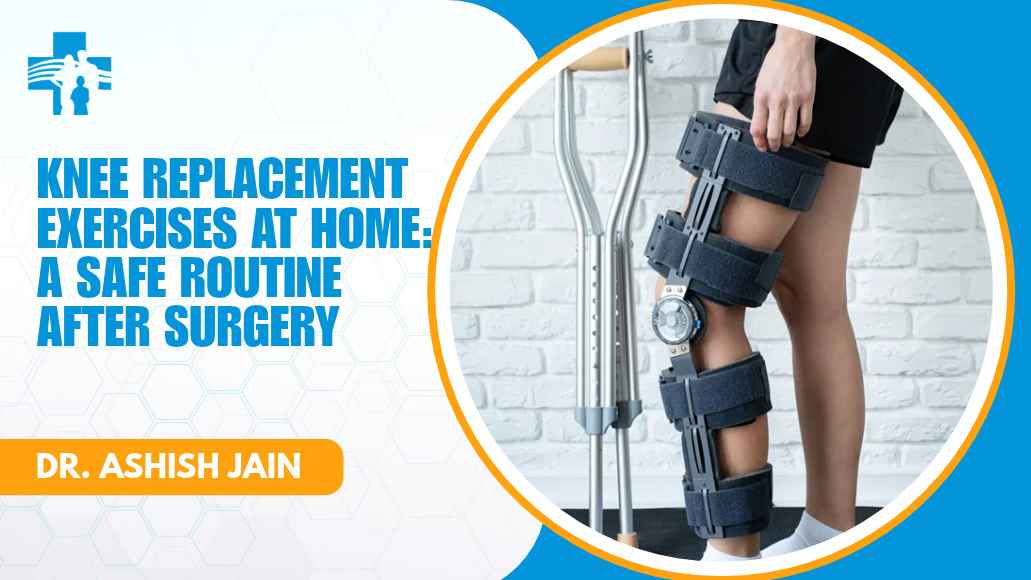
Knee replacement exercises at home are a core part of recovery, not an optional extra. The aim is to restore strength and movement, improve circulation and bring you back to everyday activities, but only in the way your surgeon and physiotherapist have approved. Most early routines include ankle pumps, thigh-tightening exercises, straight leg raises and gentle knee bending, built up gradually. Pain, swelling after surgery and stiffness are common at first. This guide walks through a typical routine, explains how to pace it and lists the signs that mean you should call your surgeon. Always follow your own team’s instructions first. You can book an appointment here.
Overview
Say you’ve just come home after a knee replacement (a hypothetical, but a very common story). The hospital physiotherapist showed you a few exercises, scribbled a sheet and said, “do these three times a day.” Now it’s the second afternoon, the knee is swollen and tight, and you’re staring at the sheet. Do you push through the pain? Do you rest? Are you doing the straight leg raise right?
Here’s the thing most people don’t hear clearly enough about knee replacement recovery exercises. Knee replacement exercises matter because recovery isn’t just the surgery. The implant gives you a new joint surface, but the muscles around it need to relearn their jobs, and the knee needs to regain bending and straightening. That’s what exercises are for.
The American Academy of Orthopaedic Surgeons (AAOS) describes the goals of exercise after total knee replacement as restoring knee strength and mobility, returning gradually to everyday activities, improving circulation in the legs and feet (which helps prevent blood clots) and reducing post-operative pain.
This guide covers a typical home routine, based on AAOS’s patient exercise guide, along with how to deal with swelling, when to progress and when to stop. Dr. Ashish Jain is a joint replacement surgeon at Max Super Speciality Hospital, Shalimar Bagh. This is general information, and your surgeon’s and physiotherapist’s instructions always take priority.
Why Do Exercises After Knee Replacement Matter?
In plain words
● Muscles weaken quickly after surgery, and the knee stiffens if it isn’t moved
● Exercise restores bending, straightening and strength
● It improves blood flow, which lowers the risk of clots
● It helps swelling and pain settle over time
● It makes walking, stairs and daily tasks easier
Rest matters, but so does moving as advised. The two aren’t opposites.
Meet Dr. Ashish Jain
Dr. Ashish Jain is a Joint Replacement Surgeon. He holds an MBBS and MS (Orthopaedics) from Kasturba Medical College, Manipal, and is a Fellow in Computer Assisted Knee Replacement Surgery (Hamburg, Germany). He is associated with Max Super Speciality Hospital, Shalimar Bagh and Max PPA Pitampura, and his listed memberships include the Delhi Orthopaedic Association, Indian Orthopaedic Association, Indian Association of Arthroplasty and the Indian Society of Hip and Knee Surgeons.
Professional Highlights
● Joint replacement surgeon offering total knee replacement and partial knee replacement
● Fellowship training in computer assisted knee replacement
● Physiotherapy listed among clinic services
● Based at Max Super Speciality Hospital, Shalimar Bagh, New Delhi
Questions about your recovery plan? Message the clinic on WhatsApp.
Before You Start: The Ground Rules
● Check first. AAOS advises checking with your therapist or surgeon before starting any exercise. Your plan may differ from a general guide
● Start early, as advised. AAOS says exercises usually begin as soon as you’re able, even in the recovery room
● Pace yourself. AAOS describes early recovery as roughly 20 to 30 minutes of exercise, two to three times a day, plus short walks. Your team sets the exact schedule
● Some discomfort is expected. Sharp, worsening pain isn’t
● Quality over quantity. Slow, controlled movements beat rushed ones
● Use a firm surface. A bed or a firm mat, with a pillow or towel as needed
Physiotherapy After Knee Replacement: What to Expect
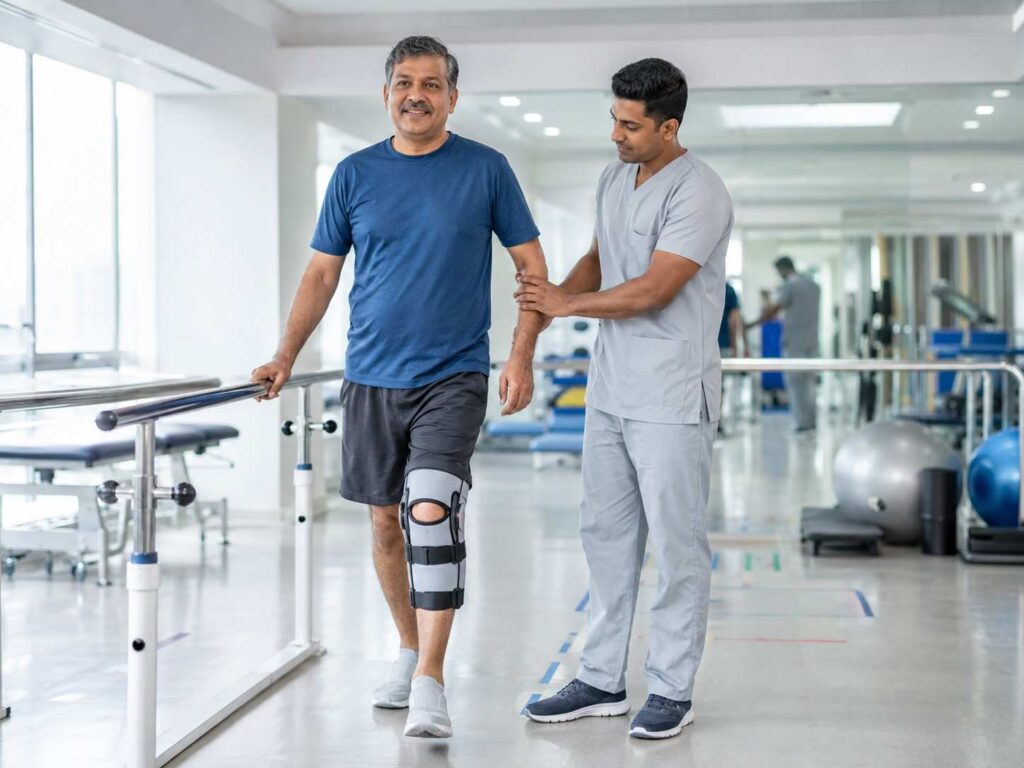
Physiotherapy after knee replacement usually starts in hospital, often the same or the next day, and continues at home or in outpatient sessions. A therapist checks your movement, teaches the exercises, corrects technique and adjusts the plan as you improve. Home exercises fill the gaps between sessions. If you’re unsure whether you’re doing an exercise correctly, ask. Don’t guess.
For a broader look at what recovery involves, see our guide on how long it really takes to recover from knee surgery.
Early Exercises After Knee Replacement: Knee Replacement Recovery Exercises
These are the basic exercises described in the AAOS guide. Hold times and repetitions are guidelines, and your therapist may change them.
1. Ankle Pumps
Lying or sitting, move your foot up and down by tightening the calf and shin muscles. AAOS suggests doing this for two to three minutes, several times an hour at first. It helps circulation and reduces ankle and lower-leg swelling.
2. Quadriceps Sets
Lying or sitting with the leg straight, tighten the thigh muscle and push the back of the knee down. Hold for 5 to 10 seconds, then relax. Repeat about 10 times, rest, and repeat until the thigh feels tired.
3. Straight Leg Raises
Straight leg raises build the thigh muscle. With the knee straight and the thigh tightened, lift the leg a few inches off the bed. Hold for 5 to 10 seconds, then lower it slowly. Continue until the thigh tires. Don’t let the knee bend as you lift, and don’t swing the leg.
4. Knee Straightening
Lie in bed with a small rolled towel under the heel, so the heel is lifted. Tighten the thigh and press the back of the knee toward the bed. Hold for 5 to 10 seconds. Getting the knee fully straight matters, which is one reason many surgeons discourage a pillow directly under the knee at night.
Knee Bending Exercises
Knee bending exercises restore the ability to sit, climb and get in and out of a car. They’re done gradually.
Bed-Supported Knee Bends
Lie on your back with both legs flat. Slide the operated foot toward your buttocks, keeping the heel on the bed. Hold for 5 to 10 seconds, then straighten. Repeat until the leg is tired.
Sitting Supported Knee Bends
Sit with your thigh supported. Place the other foot behind the operated heel to help it bend. Bend slowly, hold for 5 to 10 seconds and repeat.
Sitting Unsupported Knee Bends
Sit and bend the knee until the foot rests on the floor. Gently slide your upper body forward to bend a little more, hold for 5 to 10 seconds, then straighten.
Later Additions
AAOS also describes standing knee bends, holding a walker, and assisted knee bends using a folded towel for gentle pressure. These come later and should be introduced by your therapist.
Walking and Stairs
Walking is exercise too. AAOS suggests starting with a walker or crutches, bearing weight as directed, stepping heel first and walking smoothly without hurrying. Many people move to a cane or single crutch around two to three weeks after surgery, once they can stand and walk for more than 10 minutes without leaning on the walker, but your team decides. For stairs, the AAOS rule is “up with the good, down with the bad,” using a handrail and taking one step at a time. For more, see when you can walk without a cane after surgery.
Adding Resistance and Cycling
AAOS says resistance exercises usually start around four to six weeks after surgery, using one- to two-pound ankle weights, increased gradually. An exercise bike can be added too: set the seat so the foot just touches the pedal with the knee nearly straight, pedal backward first, and move forward only when that feels comfortable. Tension typically goes up at around four to six weeks. These are for later, with your surgeon’s approval. See our guide on what you can actually do after knee replacement surgery for the wider picture.
Swelling After Surgery: What Helps
Swelling after surgery is expected, and it can last for weeks or even months, often worse at the end of the day or after exercise. Practical steps:
● Elevate. AAOS advises elevating the leg after exercise
● Ice. AAOS suggests an ice pack, or ice wrapped in a towel, for 20 minutes on and 20 minutes off, repeated for about two hours. Never put ice directly on the skin
● Keep moving. Ankle pumps and regular, short walks help
● Don’t overdo it. Doing too much too soon can make swelling worse
● Follow your medicine plan. Under your surgeon’s advice
Signs That Mean You Should Call
Most pain and swelling are normal. But call your surgeon if you notice:
● Redness, warmth or swelling at the wound that is increasing
● Pus, foul-smelling discharge or the wound opening
● Fever or chills
● A swollen, tender or warm calf, especially on one side
● Pain that’s getting steadily worse
● A sudden loss of bending or straightening, or the knee feeling unstable
Get emergency help for chest pain, trouble breathing or a sudden cough, or if you fall and can’t bear weight. For more on spotting problems, read knee replacement infection: what warning signs actually matter.
Mistakes People Make
● Skipping exercises because the knee is sore
● Overdoing it on a good day, then flaring up
● Holding the knee bent over a pillow for long periods
● Doing random YouTube routines instead of the surgeon’s plan
● Not icing and elevating after exercise
● Ignoring calf pain or swelling
● Comparing progress with someone else’s recovery
Getting Ready Before Surgery
If you haven’t had surgery yet, learning the exercises beforehand can help. Our guide on whether prehab exercises before knee replacement actually help explains what the evidence and surgeons say.
Why Choose Dr. Ashish Jain for Knee Replacement?
Key advantages
● Fellowship training in computer assisted knee replacement
● Clear guidance before and after surgery
● Both total and partial knee replacement options
● Services at Max Super Speciality Hospital, Shalimar Bagh and Max PPA Pitampura
● Information on cost factors before you decide
Learn more about knee joint replacement, or book an appointment.
What Are the Benefits of a Good Exercise Routine?
✔ Better movement and strength in the new knee
✔ Safer, steadier walking
✔ Less stiffness and swelling
✔ More confidence in daily tasks
✔ A smoother recovery overall
Staying Informed
For general joint health updates, follow Dr. Jain on Instagram and YouTube. Results vary, and no outcome can be guaranteed.
Why Do Delhi Patients Choose Dr. Ashish Jain?
● A joint replacement focus, with knee and hip expertise
● Practical advice before and after surgery
● Easy contact via phone, WhatsApp or the contact page
● Updates on Instagram
● A convenient hospital base at Shalimar Bagh
Conclusion
Home exercises are where much of the recovery happens. Start as advised, move gently and consistently, look after the swelling and stay in touch with your physiotherapist and surgeon. Every knee recovers at its own pace, so don’t judge your progress by someone else’s. If something doesn’t feel right, call. Dr. Ashish Jain’s team is here to guide you.
Contact Dr. Ashish Jain
Email: DrAshishJRobotics@gmail.com
Phone: +91 97170 35556
WhatsApp: Message the clinic
Follow on: Instagram | YouTube
Book your knee consultation with Dr. Ashish Jain here
FAQs
What are the basic knee replacement exercises at home?
Ankle pumps, quadriceps sets, straight leg raises, knee straightening and gentle knee bends are common. Your physiotherapist will confirm which suit you.
When should I start exercises after knee replacement?
Often as soon as you’re able, sometimes in the recovery room. Check with your surgeon or therapist before starting any routine.
How often should I do the exercises?
AAOS describes early recovery as roughly 20 to 30 minutes, two to three times a day, plus walking. Your team sets your exact plan.
Why is physiotherapy after knee replacement important?
A therapist teaches and corrects the exercises, tracks your progress and adjusts the plan, which supports bending, straightening and strength.
How do knee bending exercises work?
You gradually increase how far the knee bends, using a slide, supported sitting bends and later assisted bends. They should be done slowly and as advised.
How long does swelling after surgery last?
It can last weeks or months, often worse at day’s end. Elevation, ice, gentle movement and not overdoing it can help. Report sudden or severe swelling.
Which knee replacement recovery exercises come first?
Ankle pumps and thigh-tightening exercises usually come first, then straight leg raises and gentle bending, as your team advises.
What does a straight leg raise do?
It strengthens the thigh muscle that supports the knee. Keep the knee straight, lift a few inches, hold and lower slowly.